What Is a Rigging Company? A Beginner’s Guide to Moving Heavy Equipment
August 31, 2025After 40 years in the machinery moving business, we’ve learned one crucial lesson: not every piece of equipment can handle every job. When a client calls about relocating a 50,000-pound stamping press through a facility with tight corners and low overhead clearance, we don’t reach for a standard forklift. We reach for our Versalift forklift.
The difference between using the right equipment and the wrong equipment isn’t just about efficiency—it’s about safety, precision, and whether the job gets done at all. Regular forklifts have their place in warehouses and loading docks, but when you’re moving machinery that cost millions of dollars and weighs as much as a small building, you need something built specifically for that challenge.
The Weight Problem That Standard Forklifts Can’t Solve
Walk into any warehouse in America, and you’ll likely see standard forklifts rated for 5,000 to 10,000 pounds. These workhorses handle pallets, crates, and everyday materials without breaking a sweat. But industrial machinery operates in a completely different weight class.
A typical CNC machine weighs 15,000 to 30,000 pounds. Injection molding machines often tip the scales at 40,000 pounds or more. When you start talking about stamping presses, industrial ovens, or aerospace equipment, you’re looking at loads that can exceed 60,000 pounds—sometimes much more.
This is where Versalift forklifts fundamentally change the game. The Versalift 40/60, one of the most popular models in our fleet, handles 40,000 pounds with the frame retracted and extends to lift 60,000 pounds when you need maximum capacity. The larger Versalift 60/80 pushes that envelope even further, managing loads up to 80,000 pounds. For the truly massive jobs, the Versalift 100/140 can handle anywhere from 100,000 to 140,000 pounds—capacities that make a standard forklift look like a toy.
These aren’t just bigger forklifts. The engineering behind a Versalift forklift involves extendable counterweight systems that shift the machine’s center of gravity to maintain stability under extreme loads. The frame itself extends and retracts, allowing operators to adjust capacity based on the specific requirements of each lift. This flexibility means we can tackle a wide variety of jobs with a single piece of equipment rather than maintaining separate machines for every weight class.

When Space Constraints Make Standard Equipment Impractical
Weight capacity tells only part of the story. We’ve handled countless jobs where the challenge wasn’t just how heavy the equipment was, but where it needed to go.
Manufacturing facilities weren’t designed with equipment moves in mind. Production floors have support columns every 30 feet, overhead cranes with limited clearance, and doorways that were sized for people, not machines. When you need to move a 45,000-pound machine through a space where a mobile crane won’t fit and a gantry system would take three days to set up, a Versalift forklift becomes the only practical solution.
The compact footprint of these specialized forklifts gives them maneuverability that traditional rigging equipment simply can’t match. The Versalift 40/60, for example, has a wheelbase of approximately 72 inches and an overall width of about 45 inches. That means it can navigate through standard industrial doorways and make turns in spaces where larger equipment would be completely stuck.
We recently relocated a tool and die operation where the client needed to move 12 pieces of equipment ranging from 25,000 to 55,000 pounds. The facility had 10-foot ceilings, columns spaced at irregular intervals, and active production running in the adjacent area. A crane was out of the question. A gantry system would have required shutting down production for a week. Using our Versalift forklift, we completed the entire move in three days with zero production impact.
The hydraulic boom attachment that comes standard on most Versalift models extends this capability even further. Where a standard forklift can only lift straight up from directly in front, the telescoping boom on a Versalift gives you horizontal reach. This means you can position the machine at a safe distance and still reach into tight areas or over obstacles. The boom extends up to several feet depending on the model, effectively giving you crane-like capability without needing the massive footprint and setup time of an actual crane.
The Hidden Costs of Using Inadequate Equipment
Every machinery mover has learned this lesson the hard way at some point: trying to save money on equipment rental ends up costing far more in the long run.
When you attempt a heavy machinery move with equipment that’s not quite up to the task, several things can go wrong. The most obvious risk is dropping or damaging the load, which can result in equipment damage costing hundreds of thousands of dollars—not to mention injury risks to your crew. But even when nothing catastrophic happens, using inadequate equipment inflates your costs in less visible ways.
Jobs take longer when you’re constantly stopping to reposition equipment or make multiple lifts because your forklift can’t handle the full weight in one go. Crews get fatigued working around the limitations of undersized equipment, which increases error rates and safety risks. And perhaps most significantly, production downtime extends when machinery moves drag on for days instead of hours.
We price out projects considering total cost, not just equipment rental rates. A client once asked why we recommended a Versalift forklift for a job when they could rent three standard forklifts for less money. The math was straightforward: our approach would complete the job in 8 hours with a four-person crew. Their proposed method would require 24 hours minimum, an eight-person crew, and significantly higher risk. When you factor in labor costs, extended downtime, and risk exposure, the Versalift option saved them approximately $15,000 on a job they thought would be cheaper the other way.
The dual-fuel capability found on many Versalift models (operating on either propane or gasoline) adds another layer of cost efficiency. You’re never stuck waiting for a propane delivery or scrambling to find fuel in remote locations. The flexibility to switch between fuel types means these machines keep working regardless of what’s available on-site.
Real-World Applications: Where Versalift Forklifts Excel
Theory means nothing without practical application. Over 40 years, we’ve deployed Versalift forklifts across every industrial sector you can imagine, and certain patterns have emerged about where they provide the most value.
Automotive and Stamping Operations
Stamping presses represent some of the heaviest, most awkward loads in industrial moving. A 700-ton press can weigh 60,000 pounds just for the base, and it needs to be positioned with millimeter precision for proper operation. The Versalift 60/80 has become our go-to equipment for these jobs because it combines the capacity to handle these extreme weights with the fine control needed for precision placement.
We recently handled a press line reconfiguration where six presses needed to be repositioned within an existing facility. The floor space was tight, and the client couldn’t afford more than a weekend shutdown. Using two Versalift forklifts working in tandem, we completed all six moves in 36 hours. The alternative—bringing in mobile cranes—would have required removing part of the facility roof and a two-week timeline.
Aerospace and Defense Manufacturing
Aerospace facilities present unique challenges. Equipment is often both heavy and extraordinarily expensive, with some machines valued at $5 million or more. The tolerances are tight, the floors may not be rated for heavy point loads, and security considerations often limit who can access the facility.
Versalift forklifts distribute weight over a larger footprint than traditional forklifts, which reduces point loading on floors. The hydraulic controls provide the fine adjustment needed to position equipment within tight tolerances. And because one operator can handle the entire machine, you minimize the number of people who need security clearances to complete the job.
Medical and Pharmaceutical Manufacturing
Clean room environments eliminate many traditional rigging options. You can’t bring in a dirty diesel crane, and you can’t have dozens of workers tracking contamination through controlled areas. The compact, clean-running nature of a propane-powered Versalift forklift makes it ideal for these environments.
We’ve moved MRI machines, pharmaceutical mixing equipment, and precision laboratory instruments in settings where a single particle of contamination could ruin a million-dollar batch. The enclosed operator cab and sealed hydraulic systems minimize contamination risk, while the equipment’s capacity handles the substantial weight of medical and pharmaceutical machinery.
Food and Beverage Production
Industrial ovens, mixing systems, and packaging lines in food production facilities often weigh 30,000 to 50,000 pounds. These facilities operate 24/7 in many cases, which means moves need to happen fast during scheduled maintenance windows. The Versalift 40/60 has become our standard equipment for these jobs because it can move quickly, doesn’t require extensive setup, and provides enough capacity for virtually any piece of food production equipment.
Technical Advantages That Separate Versalift from Alternatives
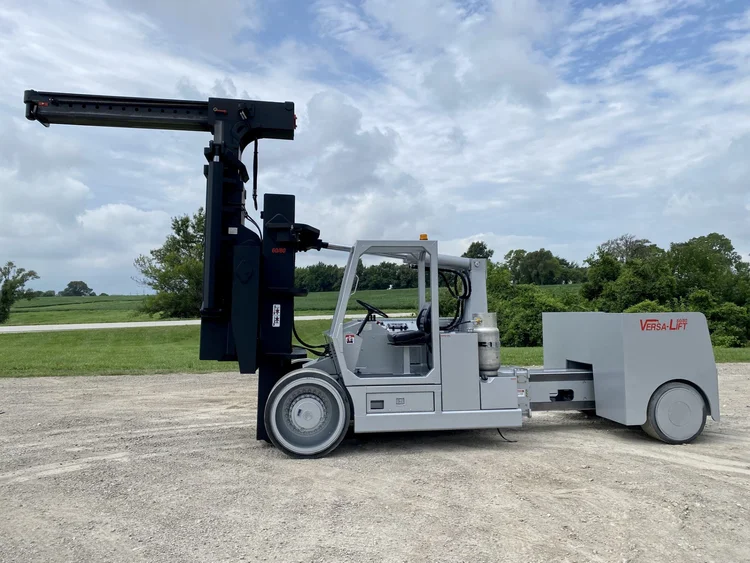
When machinery movers discuss equipment, certain technical specifications matter more than others. For Versalift forklifts, several design features distinguish them from both standard forklifts and alternative heavy-moving equipment.
Extendable Counterweight System
The signature feature of every Versalift forklift is its extendable counterweight base. Unlike a standard forklift where the counterweight is fixed, Versalift models use a hydraulic system to extend the rear counterweight as you increase the load. This maintains proper weight distribution and stability regardless of whether you’re lifting 25,000 pounds or 60,000 pounds.
This system also allows the machine to retract when moving through tight spaces, then extend when stability matters most. You get the maneuverability of a compact machine with the stability of a much larger one.
Hydrostatic Transmission
Most Versalift forklifts use hydrostatic transmission systems, which provide smooth, infinitely variable speed control. When you’re moving a 50,000-pound injection molding machine, you don’t want jerky starts and stops. Hydrostatic systems let operators make micro-adjustments to position and speed, which is essential for precision work.
The transmission also provides excellent slow-speed control, allowing operators to creep along at inches per minute when positioning equipment. This level of control is impossible with standard mechanical transmissions.
Cushion Tire Design
While pneumatic tires work well outdoors, most industrial facilities have smooth concrete floors where cushion tires excel. Versalift forklifts typically use cushion tires that provide a smaller turning radius, better stability on smooth surfaces, and less floor damage than pneumatic alternatives.
The cushion tire design also keeps the overall height of the machine lower, which matters when you’re working in facilities with limited overhead clearance.
Optional Remote Control Systems
Many Versalift models can be equipped with remote control systems that allow operators to control the machine from outside the cab. This feature becomes critical in situations where the operator needs to see around obstacles or maintain visual contact with spotters during precision positioning.
Remote control also improves safety by allowing the operator to stand clear of the machine during high-risk portions of a lift. We’ve used this feature countless times when moving equipment in areas where the operator’s line of sight from the cab would be blocked.
Safety Considerations That Make Versalift the Smart Choice
Every machinery move carries inherent risks. Equipment that weighs tens of thousands of pounds doesn’t forgive mistakes. Over four decades, we’ve learned that using purpose-built equipment like Versalift forklifts isn’t just about capability—it’s about safety.
The stability of a Versalift forklift under heavy loads exceeds standard forklifts by a substantial margin. The extended counterweight system automatically adjusts to maintain proper weight distribution, which significantly reduces tip-over risk. The lower center of gravity compared to alternatives like mobile cranes provides additional stability, especially on surfaces that aren’t perfectly level.
Load monitoring systems on modern Versalift models provide real-time feedback on weight distribution and stability. Operators can see when they’re approaching capacity limits or when load position becomes dangerous. This immediate feedback prevents the kind of judgment errors that cause accidents with less sophisticated equipment.
The enclosed operator cab found on most models protects the operator from falling objects, collision hazards, and environmental factors. When you’re moving heavy machinery, things sometimes go wrong. An enclosed cab provides a critical layer of protection that open-air equipment doesn’t offer.
Perhaps most importantly, Versalift forklifts are designed specifically for heavy machinery moving. Every control, safety system, and structural element accounts for the unique stresses and requirements of this work. Standard forklifts pressed into heavy-duty service lack these specialized design features, which translates directly into higher risk.
The Economics of Owning vs. Renting Versalift Equipment
For machinery moving companies and facilities that regularly relocate heavy equipment, the question inevitably arises: should you buy a Versalift forklift or rent one when needed?
New Versalift forklifts range from approximately $150,000 for smaller models like the 25/35 to more than $300,000 for the larger 100/140. That’s a substantial investment, but the math can work out favorably for companies with consistent demand.
If you’re paying $3,000 to $5,000 per week to rent a Versalift forklift, and you have projects requiring one for 20+ weeks per year, ownership begins to make financial sense within three to five years. The additional benefit comes from having the equipment available immediately rather than coordinating rental schedules, and from building operator expertise with a consistent piece of equipment.
Used Versalift forklifts offer a middle ground, with well-maintained units from 2010-2015 available in the $75,000 to $150,000 range depending on model and condition. These machines were built to last, and we’ve seen 2000-era units still operating effectively with proper maintenance.
For companies with occasional heavy moving needs, rental remains the practical choice. The flexibility to select the exact right capacity for each job, combined with no maintenance costs or depreciation concerns, makes rental attractive when utilization would be low.
At J.V. Rigging, we own multiple Versalift models because we use them constantly. Our fleet includes 40/60 and 60/80 models that see action on jobs ranging from single machine moves to complete facility relocations. The investment pays for itself through reduced equipment rental costs, better scheduling flexibility, and the competitive advantage of having the right equipment immediately available.
Maintenance and Operational Considerations
Owning or operating a Versalift forklift comes with specific maintenance requirements that differ from standard forklifts. Understanding these considerations helps explain why these machines deliver reliable performance in demanding applications.
The hydraulic systems require regular inspection and fluid changes. With multiple hydraulic cylinders managing the extendable counterweight, boom operation, and lifting functions, maintaining clean hydraulic fluid and monitoring for leaks becomes critical. We inspect hydraulic hoses before every job and perform complete hydraulic system servicing every 500 operating hours.
Engine maintenance follows standard industrial engine protocols, but the demands on these engines exceed typical forklift use. Moving 60,000-pound loads generates significant strain, and engines work hard in these applications. We’ve found that following manufacturer maintenance schedules religiously and using premium lubricants extends engine life substantially.
The counterweight extension mechanism represents the most unique maintenance requirement. The rails, rollers, and hydraulic cylinders that allow the counterweight to extend and retract need regular lubrication and inspection. Dirt and debris can interfere with smooth operation, so keeping these components clean is essential.
Tire wear patterns differ from standard forklifts due to the extreme loads. We rotate tires regularly and monitor for uneven wear that might indicate alignment issues or operational technique problems. The cushion tires used on most models typically last 3,000 to 5,000 operating hours under normal conditions, but heavy use can reduce this substantially.
Operator training represents another critical consideration. These aren’t machines you can hand over to any forklift driver. The combination of extreme capacities, extendable components, and precision requirements demands specialized training. We invest approximately 40 hours training each operator on Versalift equipment before allowing them to handle actual jobs, and we provide ongoing skill development to maintain proficiency.
Why J.V. Rigging Relies on Versalift Forklifts
After four decades in the machinery moving business, we’ve tried virtually every approach to moving heavy equipment. We’ve used mobile cranes, gantry systems, hydraulic jacks and skates, air cushion systems, and every variety of forklift ever manufactured.
Through all that experience, Versalift forklifts have proven themselves as the most versatile, reliable, and cost-effective solution for the majority of our heavy machinery moves. They combine capacity that rivals crane systems with maneuverability that those systems can’t match. They cost less to operate than maintaining multiple pieces of specialized equipment while handling a wider variety of jobs.
Our clients notice the difference. When we show up with a Versalift forklift instead of a convoy of standard forklifts or a mobile crane that requires closing streets and removing overhead obstructions, they understand immediately that we’ve thought through the most efficient approach. Jobs that other companies quote at multiple weeks get completed in days. Moves that seem impossible in existing facilities happen smoothly with minimal disruption.
The reliability of these machines matters just as much as their capabilities. We’ve never had a Versalift forklift fail mid-job, which would be catastrophic when you’re holding 50,000 pounds of equipment in the air. The robust construction and commercial-grade components deliver the dependability that professional machinery movers require.
For facilities considering their own heavy machinery moving capabilities, or for companies evaluating machinery moving contractors, understanding the role of specialized equipment like Versalift forklifts provides insight into what separates professional operations from those cutting corners. When someone shows up to move your multi-million dollar equipment with inadequate tools, the savings aren’t really savings—they’re just deferred costs that will show up as delays, damage, or worse.
Making the Right Equipment Choice for Your Next Heavy Machinery Move
Not every machinery move requires a Versalift forklift. For lighter equipment under 15,000 pounds in open spaces with plenty of room to maneuver, standard heavy-duty forklifts work perfectly well. The key is matching equipment capabilities to job requirements.
When evaluating whether a job demands a Versalift forklift, consider these factors:
Load Weight: Anything over 30,000 pounds generally requires specialized equipment. Between 15,000 and 30,000 pounds, evaluate other factors to determine the appropriate equipment.
Space Constraints: If you’re working in a facility with limited overhead clearance, tight doorways, or congested production areas, the maneuverability of a Versalift forklift often makes the difference between possible and impossible.
Precision Requirements: Equipment that must be positioned within tight tolerances benefits from the fine control that Versalift hydraulic systems provide.
Time Sensitivity: When downtime costs thousands of dollars per hour, the speed advantage of using the right equipment from the start justifies higher equipment costs.
Floor Conditions: Smooth concrete floors are ideal for Versalift operation. Outdoor moves or rough surfaces might require different equipment approaches.
Accessibility: If the move involves multiple lifts, repositioning, or working around obstacles, having boom capability and adjustable counterweights simplifies the job substantially.
Professional machinery moving companies evaluate all these factors before quoting projects. The goal isn’t to use the most impressive equipment—it’s to use the right equipment that gets the job done safely, efficiently, and cost-effectively.
Experience Makes the Difference
Equipment alone doesn’t guarantee successful machinery moves. A Versalift forklift in inexperienced hands can be just as problematic as inadequate equipment in expert hands. The combination of purpose-built equipment and experienced operators creates the foundation for professional machinery moving.
Our crews have collectively operated Versalift forklifts for thousands of hours across every industrial sector. They understand how these machines behave under different loads, how to optimize stability in challenging situations, and how to work efficiently while maintaining safety. That experience translates directly into faster, safer moves for our clients.
We’ve moved everything from 10,000-pound CNC lathes to 120,000-pound stamping press bases using Versalift equipment. We’ve worked in aerospace clean rooms, food production facilities, automotive plants, medical device manufacturers, and tool and die shops. Every industry has unique requirements, and we’ve learned how to adapt our approach while maintaining the core principles that make heavy machinery moving successful.
When clients call with challenging moves—equipment that previous contractors said couldn’t be done, or situations where the timeline seems impossible—we often find that the right equipment combined with experienced operators makes the “impossible” remarkably straightforward.
Ready to Move Your Heavy Machinery the Right Way?
At J.V. Rigging, we’ve built our reputation on having the right equipment, the right expertise, and the right approach to handle your most challenging machinery moves. With over 40 years of experience and specialized equipment including Versalift forklifts capable of handling loads from 25,000 to 140,000 pounds, we’re equipped to tackle projects that other companies can’t.
Whether you’re relocating a single piece of equipment or planning a complete facility move, we’ll evaluate your specific requirements and recommend the most efficient approach. Our nationwide service capabilities mean we can handle your project regardless of location, and our experienced crews ensure your valuable equipment is moved safely and precisely.
Contact us today to discuss your machinery moving project and get a detailed quote or call (724) 339-8900 to speak with one of our project specialists. Let us show you why businesses across the United States trust J.V. Rigging for their most critical machinery moving needs.