
How to maintain machinery storage facilities to prevent rust and damage
February 25, 2026
Picking the wrong crane for a job site doesn’t just slow things down. It can blow your budget, delay your timeline, or put crew safety at risk. Construction projects rarely call for “a crane.” They call for a specific type of crane service matched to the load, the site conditions, and the height or reach the job demands.
Whether you’re lifting structural steel on a high-rise, setting HVAC units on a commercial roof, or moving heavy equipment into an industrial facility, understanding the different types of crane services available helps you plan smarter and avoid costly surprises. Here’s a breakdown of the seven crane types you’re most likely to encounter on construction sites, what each one does best, how cost and logistics factor in, and how to know which one fits your project.
1. Mobile Cranes
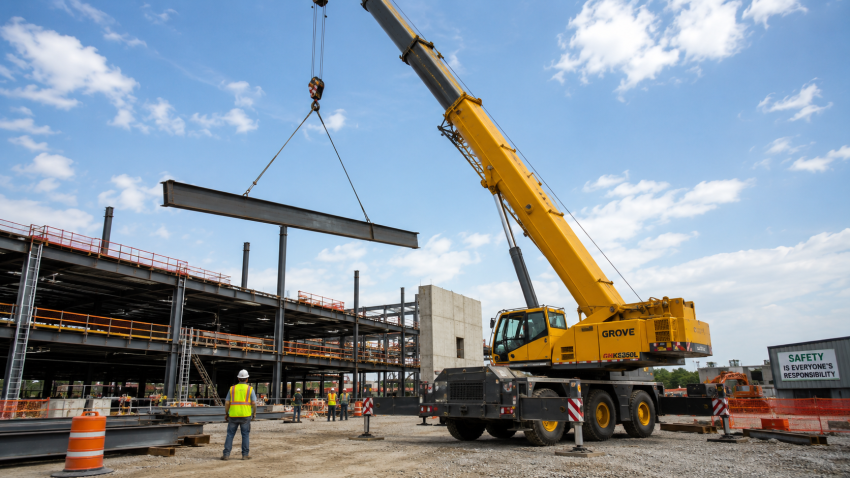
Mobile cranes are the most commonly used crane service on construction sites because of their versatility. Mounted on rubber tires or a truck chassis, they drive directly to the site, set up quickly, and can relocate between job sites without needing to be disassembled. Most mobile cranes use a telescopic boom that extends and retracts, giving operators flexibility for lifts at varying heights and distances.
Capacities typically range from 30 to over 500 tons, depending on the model, which makes mobile cranes suitable for everything from small commercial builds to larger industrial lifts. They’re a strong choice when a project needs a crane for a short duration or when the job involves multiple lift locations across a single site. The tradeoff is ground stability. Mobile cranes need fairly level, compacted ground to operate safely, so they’re not always the right fit for rough or uneven terrain.
Most jurisdictions require a licensed, certified operator to run a mobile crane, and the lift itself often needs a documented lift plan before work begins, especially near power lines or existing structures. On a typical commercial job, a mobile crane might be on site for a day or two to set rooftop equipment, place precast panels, or assist with structural steel, then move on to the next location. Because of that flexibility, it’s often the most cost-effective crane service for shorter-duration lifts.
2. All-Terrain Cranes
All-terrain cranes combine the road speed of a mobile crane with the off-road capability needed for less predictable job sites. They’re built with multi-axle chassis and all-wheel drive or steering, which lets them travel on highways to reach a site, then maneuver across gravel, mud, or sloped ground once they arrive.
This crane service is common on construction projects spread across larger properties, like industrial parks, energy sites, or infrastructure builds where the crane has to cross varied terrain to reach the lift point. All-terrain cranes also tend to offer higher lifting capacities than standard mobile cranes, with some models rated for 1,000 tons or more, making them a practical option when a project needs both mobility and serious lifting power in one machine.
Because they can self-drive between locations instead of being hauled on a trailer, all-terrain cranes also cut down on mobilization time and cost when a project spans multiple buildings or phases. They’re a common sight on utility-scale solar and wind projects, pipeline work, and other infrastructure jobs where the crane needs to relocate frequently across a large footprint. Renting this crane service usually means paying for both the machine and a certified operator, with day rates climbing as capacity and boom length increase.
3. Rough-Terrain Cranes
Rough-terrain cranes are purpose-built for off-road conditions and are not designed to travel on public roads, so they’re typically transported to the site on a trailer. With large rubber tires and four-wheel drive, they handle uneven, soft, or sloped ground better than most other crane types, which makes them a go-to crane service for sites still in early-stage development, like new construction with unfinished access roads or grading.
These cranes are compact compared to other mobile units, which gives them an advantage in tighter job sites where maneuvering space is limited. Capacities generally fall between 15 and 130 tons, putting them in a good range for mid-size commercial construction, utility work, and material handling on sites where ground conditions rule out a standard mobile crane.
Operators favor rough-terrain cranes for projects in their early phases because the crane can navigate dirt, gravel, and slopes that haven’t been graded or paved yet. This makes them a popular crane service choice for residential subdivisions, road and bridge work, and commercial sites still under site development. Because they’re hauled to the job on a trailer rather than driven, scheduling needs to account for trailer availability and a short setup window once the crane arrives.
4. Crawler Cranes
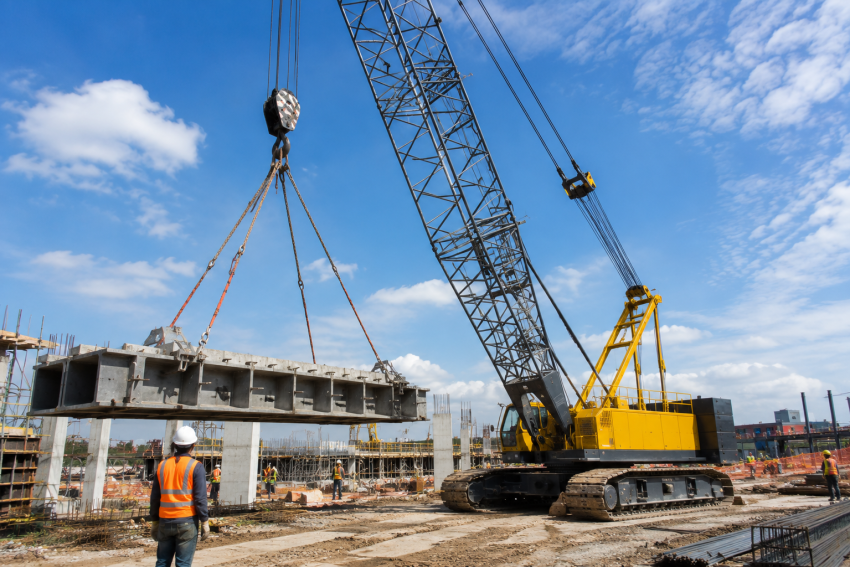
Crawler cranes run on tracks instead of wheels, which gives them excellent stability and ground pressure distribution, even on soft or unstable surfaces. Because the tracks spread the machine’s weight over a larger area, crawler cranes can often lift without the need for outriggers, allowing them to move while carrying a load, something most other crane types can’t do.
This crane service is typically reserved for heavy lifts on large-scale construction projects, such as high-rise buildings, bridges, and industrial facilities. Capacities can reach well into the thousands of tons for the largest models, making crawler cranes the standard choice when a project involves lifting oversized structural components, large mechanical equipment, or modular building sections. The main consideration is mobility between sites. Crawler cranes are usually disassembled and transported on multiple trucks, then reassembled on site, which adds time and cost compared to a mobile or all-terrain crane.
The tradeoff for that lifting power is logistics. Mobilizing a crawler crane can take several trucks and a few days of assembly before it’s ready to lift, and the same process runs in reverse once the job is done. For that reason, this crane service is usually reserved for projects where the lift requirements genuinely call for it, rather than as a default option. Many contractors bring in a crawler crane for a single critical lift, like setting a roof truss system or placing a large precast element, then release it once that phase wraps up.
5. Tower Cranes
Tower cranes are the fixed, vertical cranes most people picture when they think of a city skyline under construction. Anchored to a concrete foundation and assembled piece by piece on site, tower cranes offer exceptional height and lifting radius, which makes them the standard crane service for mid-rise and high-rise building projects.
There are two main configurations: hammerhead tower cranes, which have a horizontal jib that doesn’t move, and luffing jib tower cranes, which can angle the jib up or down. Luffing cranes are often used on dense urban sites where the crane’s swing radius needs to stay within tighter property lines. Tower cranes stay in place for the duration of the project, sometimes for a year or more, and are removed once the structure tops out.
Because tower cranes stay erected for months at a time, they require ongoing inspection, a licensed operator on site for the duration of the project, and coordination with a structural engineer for the foundation and tie-in points as the building rises. Permitting requirements also tend to be more involved than with mobile crane types, since the crane is a fixed structure on the property for an extended period. Despite the added planning, tower cranes are often the most efficient crane service for tall buildings, since they eliminate the need to constantly remobilize equipment as the structure grows.
6. Telescopic Boom Trucks
Telescopic boom trucks, sometimes called boom trucks or truck-mounted cranes, are built on a standard truck chassis with a hydraulic boom mounted behind the cab. They’re smaller and faster to deploy than most other crane services on this list, which makes them a practical choice for lighter lifts like setting rooftop units, placing precast materials, or unloading deliveries on a job site.
Boom trucks typically max out in the 15 to 40-ton range, so they’re not built for heavy structural lifts, but their speed and lower mobilization cost make them a smart option for projects where a full mobile or crawler crane would be more than what’s needed. Many construction crews keep a boom truck on call for routine lifts throughout a project’s timeline rather than scheduling a larger crane for smaller tasks.
Because they mobilize quickly and don’t require the site prep that larger cranes do, boom trucks tend to be one of the more affordable crane service options on a per-lift basis. They’re a practical fit for retail buildouts, small commercial renovations, and any job where the lift itself takes an hour or two rather than a full day. Many rigging and crane companies keep a boom truck in their fleet specifically to handle these smaller, faster jobs without tying up larger equipment.
7. Overhead and Gantry Cranes
Overhead cranes, also called bridge cranes, and gantry cranes are a different category from the mobile crane types above. Instead of traveling to a site, they’re typically installed within a facility, running along a fixed rail system mounted to the building structure or supported by freestanding legs. On construction projects, this crane service usually comes into play during the buildout of manufacturing plants, warehouses, or industrial facilities where the finished space will need permanent overhead lifting capability.
Gantry cranes offer a similar function but don’t require the same overhead rail infrastructure, since they’re supported by their own legs and can sometimes be moved if needed. Both options are built for repetitive, controlled lifting within a defined space rather than the open-site lifting handled by mobile or crawler cranes, and they’re often installed near the final stages of a construction project once the building shell is in place.
Unlike the other crane types on this list, overhead and gantry cranes aren’t typically rented for a single project. They’re installed as part of the building’s permanent infrastructure, often by a rigging contractor who also handles the heavy equipment that will eventually run beneath them. Manufacturing facilities, distribution centers, and maintenance shops rely on this crane service long after construction wraps, since it becomes part of daily operations rather than a temporary lift solution.
What Affects Crane Service Costs on a Construction Project
Crane rental pricing depends on more than just the size of the machine. Capacity, boom length, mobilization distance, and how long the crane is needed on site all factor into the final cost, and that’s before accounting for the operator, rigging crew, and any permits required for the lift. A same-day boom truck rental for a light lift might run a few hundred to a couple thousand dollars, while a tower crane installed for a multi-month build can represent a six-figure line item once setup, operation, and dismantling are included.
Site conditions also play a role. A lift that requires a police escort for road closures, a crane mat to protect underground utilities, or engineering review for a lift near power lines will all add cost beyond the base rental rate. Getting an accurate quote means giving the crane service provider as much detail as possible up front, including load weights, lift radius, ground conditions, and the project timeline, so they can recommend the right equipment without scope creep once the crane is on site.
How to Choose the Right Crane Service for Your Project
With seven distinct crane types available, choosing the right one comes down to a handful of project-specific factors:
- Load weight and dimensions: what you’re lifting determines the minimum capacity needed, with room to spare for safety margins
- Lift height and radius: how high and how far the crane needs to reach from its set position
- Ground conditions: whether the site can support a mobile or all-terrain crane, or whether crawler tracks or trailer-mounted rough-terrain capability are needed instead
- Project duration: a one-day lift calls for a different crane service than a project requiring months of overhead lifting capability
- Site access and space: how much room is available for the crane to set up, swing, and maneuver around other site activity
A crowded urban site with a long-term vertical build points toward a tower crane. A short-term industrial lift on uneven ground might call for a rough-terrain or crawler crane instead. Getting this decision wrong, by undersizing capacity or choosing a crane that can’t handle site conditions, tends to cost more in delays and remobilization than it would have cost to plan correctly from the start. That’s where working with an experienced crane service provider makes the difference. A team that’s handled a wide range of construction and industrial lifts can assess the project specifics and recommend the right crane the first time, rather than leaving it to guesswork.
If you’re planning a lift for an upcoming construction or industrial project and need a rigging company in Pennsylvania, explore our crane rental services for a fleet of well-maintained cranes and experienced, certified operators who handle everything from single lifts to full-scale plant relocations, or call us at (724) 339-8900 to talk through what your project needs.

